
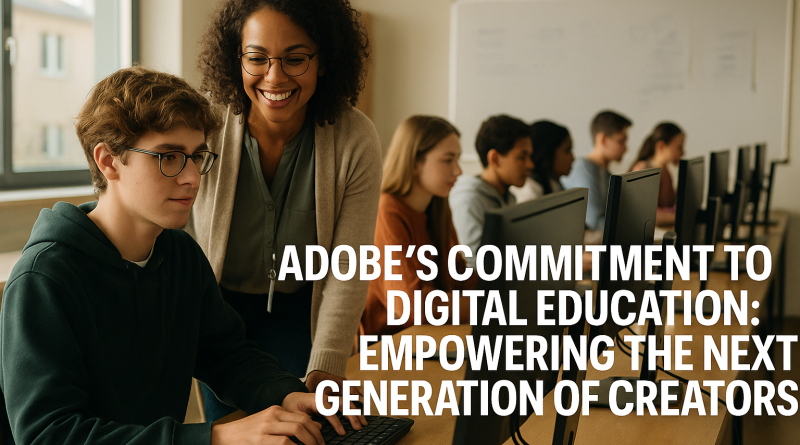
Adobe and Digital Education: Shaping the Next Generation of Creatives
Adobe’s Commitment to Digital Education: Empowering the Next Generation of Creators
This article may contain affiliate links. This means we may earn a small commission if you make a purchase, at no extra cost to you.
In a world where digital literacy is becoming as essential as traditional reading and writing, Adobe stands as a driving force in shaping the future of creative education. Known globally for its industry-leading tools in design, multimedia, and digital storytelling, Adobe has also emerged as a champion for accessible, high-impact digital learning. Its mission goes far beyond software — it’s about empowering students and educators to thrive in a technology-driven world.
1. Expanding Access: Democratizing Digital Creativity
Adobe’s commitment to accessibility plays a pivotal role in leveling the educational playing field. Through deeply discounted student plans, institutional licenses, and Creative Cloud access programs, Adobe ensures that learners from all backgrounds can use the same professional tools that define the creative industries today.
Why this matters
-
Students gain hands-on experience with real-world creative tools
-
Schools integrate modern digital skillsets into everyday learning
-
Access to Photoshop, Illustrator, InDesign, Premiere Pro, and more becomes universal
By removing financial barriers, Adobe helps democratize creativity and elevate digital literacy across diverse communities.
2. Creativity in the Curriculum: Learning Beyond Software
Adobe’s focus on education extends far beyond teaching students how to use software. The company advocates for creative problem-solving across all disciplines, positioning creativity as a foundational skill in modern learning.
Tools that transform the classroom
-
Adobe Express (formerly Spark) helps students create videos, webpages, and visual stories
-
Creative Cloud apps help teachers embed design, media, storytelling, and visual communication into lessons
-
Students learn not only technical skills but also communication, analysis, and innovation
Incorporating Adobe tools into the curriculum encourages students to think critically, express ideas visually, and apply creativity to real-world challenges.
3. Empowering Educators: Adobe Education Exchange
Educators are central to Adobe’s mission. The Adobe Education Exchange—a free learning and collaboration platform—provides:
-
Self-paced courses
-
Teaching materials
-
Ready-to-use classroom projects
-
Professional development opportunities
-
A global community of creative educators
Teachers gain confidence using digital tools, explore best practices, and integrate creativity into subjects ranging from language arts to STEM.
4. Certification and Career Readiness
Adobe goes a step further by preparing students for the professional world through its Adobe Certified Professional programs.
These certifications validate mastery of tools such as:
-
Photoshop
-
Illustrator
-
InDesign
-
Premiere Pro
-
After Effects
Benefits for students
-
Stronger resumes
-
Industry-recognized credentials
-
Competitive advantage in creative and digital careers
Adobe ensures that students graduate not only with knowledge, but with credible proof of their digital skillset.
5. Addressing the Digital Divide
Despite Adobe’s advancements, the digital divide remains a challenge: many students still lack access to devices, stable internet, or training. Adobe works closely with:
-
Schools
-
Nonprofits
-
Governments
-
Community organizations
…to expand digital access, provide training resources, and support underserved communities.
By focusing on inclusivity, Adobe reinforces its mission to make creativity and learning accessible for everyone.
6. The Future: Creativity as a Core Competency
As the future of work shifts toward automation, AI, and constant technological innovation, creativity is becoming one of the most valuable skills anyone can possess.
Adobe is actively shaping this future by:
-
Investing in educational technology
-
Expanding Creative Cloud’s learning resources
-
Enhancing tools with AI through Adobe Sensei
-
Supporting cross-disciplinary digital learning
-
Fostering modern creative problem-solving
Adobe’s vision positions creativity not as an optional skill — but as a core competency essential for the next generation.
Conclusion: Adobe’s Lasting Impact on Education
Adobe’s influence reaches far beyond professional creative fields. Through accessible tools, educator training, curriculum integration, and global educational initiatives, Adobe is empowering students and teachers to imagine, design, innovate, and solve problems in ways that were once impossible.
Adobe’s commitment to digital education lays the foundation for a future in which creativity and technology go hand in hand — and where every student, no matter their background, has the tools to build brighter possibilities.